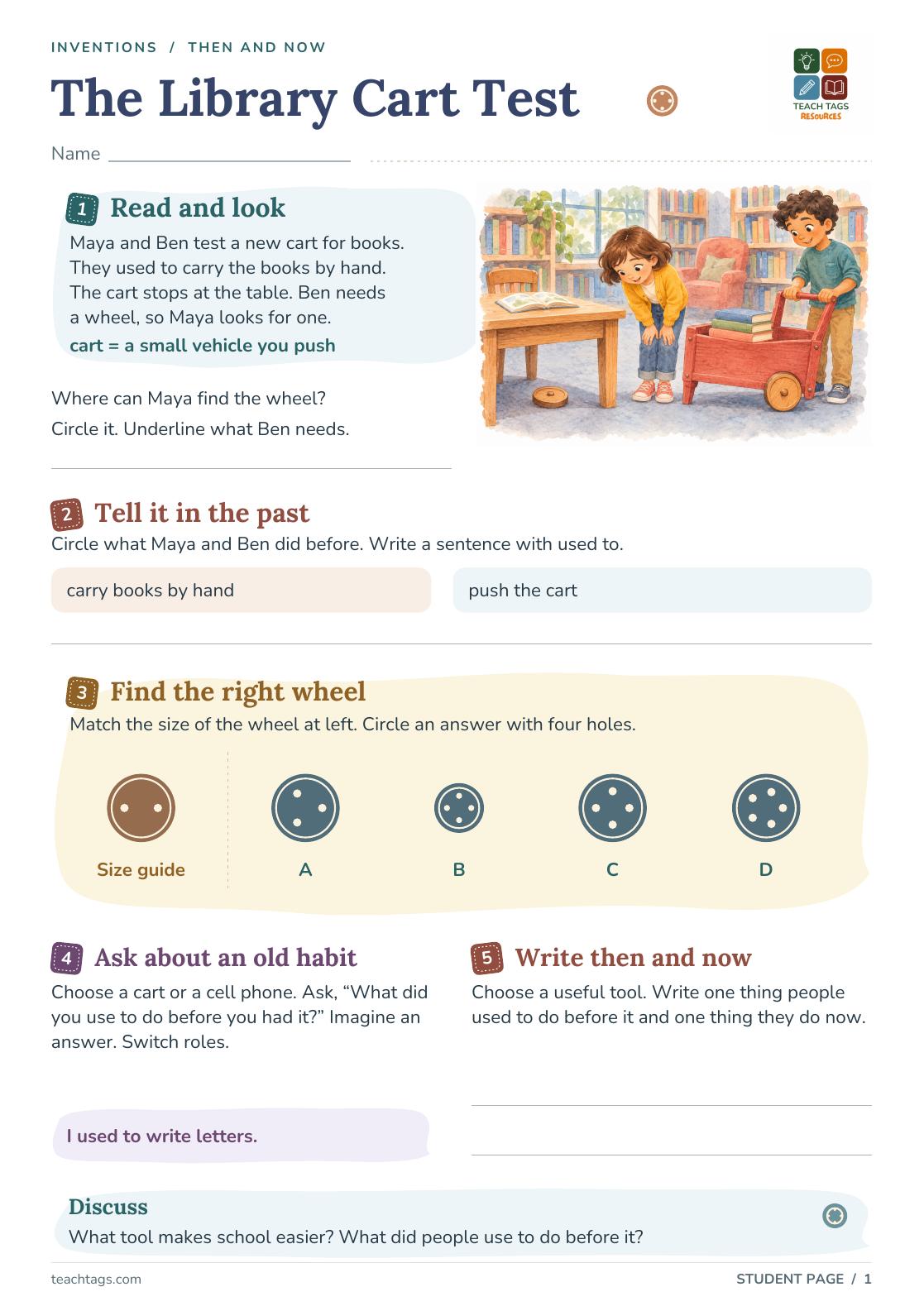
This illustrated worksheet helps upper-elementary English learners talk about past habits and explain how tools change everyday tasks. Learners use a story and a library scene to find a missing wheel, solve a visual puzzle, and write about what people did before a tool and what they do now.
Target Vocabulary
wheel, useful, inventions.
Support Words
cart, by hand, holes.
Target Language
Use used to plus a base verb for a past habit. Ask with did … use to. Use the present simple to say what happens now.
Activity
- Read and look. Combine the story and illustration to find the missing wheel.
- Tell it in the past. Identify the old habit and rewrite it with used to.
- Find the right wheel. Compare wheel sizes and count holes to find the only answer that fits both clues.
- Ask about an old habit. Pick a tool and take turns asking and answering about life before it.
- Write then and now. Choose a useful tool and write a past habit and a present-day contrast.
Learning Goal
Use text and picture evidence to locate a missing part, then describe past habits with used to and contrast them with present routines.
Suggested Textbook Connections
| Textbook Name | Unit Number & Title | Context / Notes |
|---|---|---|
| Our World Level 4 (Second Edition, American English) | Unit 7 · Good Idea! | Full match. Reinforces inventions vocabulary and used to for past habits. Use after Vocabulary 1 and Grammar 1. |
| Super Minds Level 4 (Second Edition, British English) | Unit 5 · Police! | Partial match. The course map lists used to in a unit on describing people. This worksheet transfers the structure to tools and everyday tasks. |