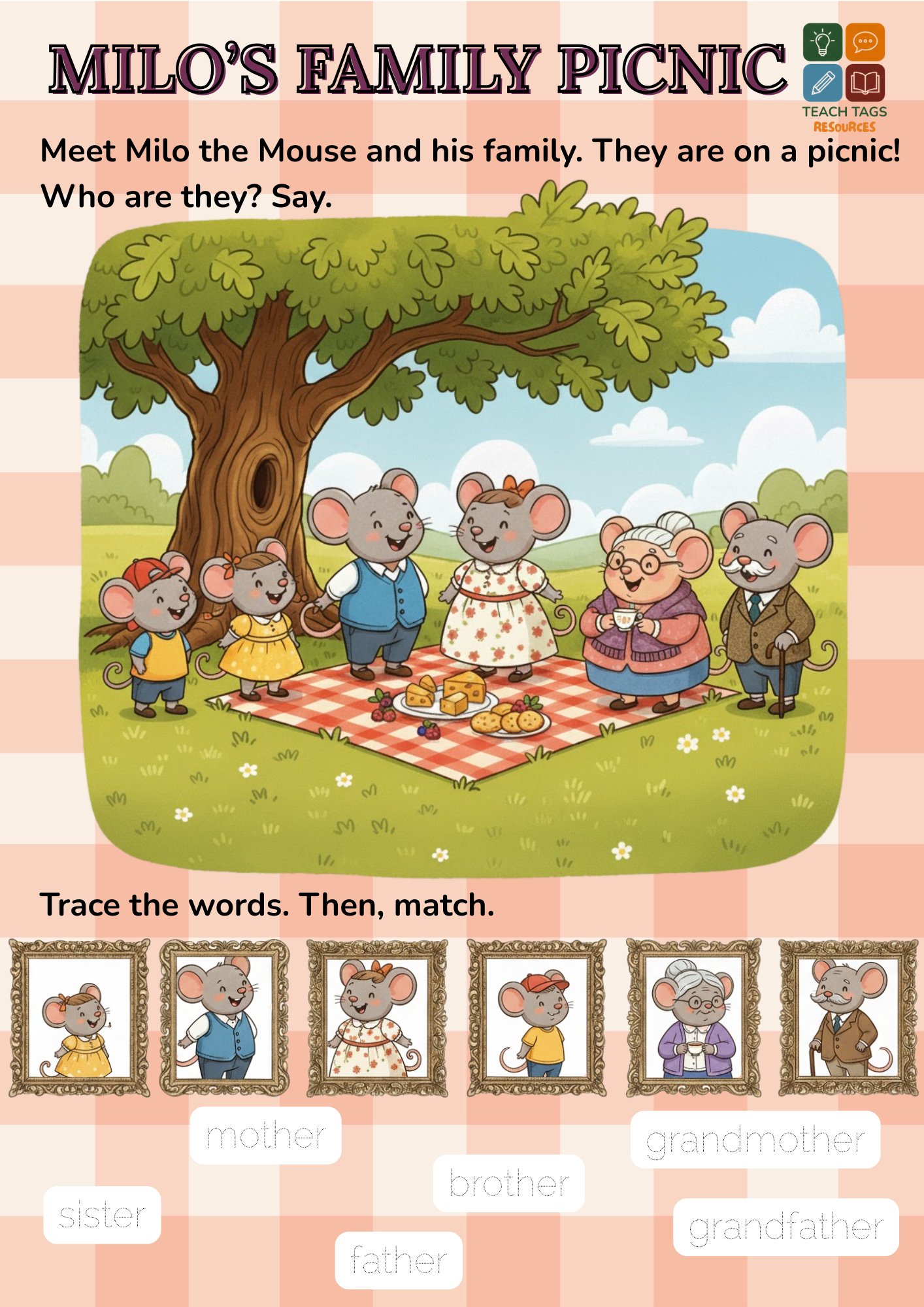
This engaging two-page worksheet set uses the character “Milo the Mouse” to introduce and practice family member vocabulary with young learners. The resource combines visual recognition with fine motor skill development through tracing and matching exercises on the first page, followed by a gamified maze activity and a creative drawing section on the second page. It is designed to make learning family terminology interactive and personal for students at the beginner level.
Target Grade Level: Kindergarten – 1st Grade (CEFR Pre-A1)
Target Vocabulary: Mother, Father, Sister, Brother, Grandmother, Grandfather
Activities
Students look at the scene and portraits to answer the prompt “Who are they? Say.”
Learning Goal: Students will be able to recognize, pronounce, and spell basic family member terminology while developing fine motor skills through tracing and drawing.
| Textbook Name | Unit Number & Title | Context & Mapping Details |
| Everybody Up 1 (2nd Edition) | Unit 4: Home | Exact Match. Lesson 1 of this unit is explicitly titled “Family” and teaches the exact vocabulary list: mother, father, brother, sister, grandmother, grandfather. The “Home” theme often integrates dining/food contexts similar to a picnic. |
| Kid’s Box 1 (Updated/New Gen) | Unit 4: My Family | Exact Match. This unit is dedicated entirely to family members. The vocabulary covers grandmother, grandfather, mother, father, sister, brother. The character-driven nature of Kid’s Box (using the Star family) mirrors the “Milo’s family” storytelling approach. |
| Family and Friends 1 (2nd Edition) | Unit 8: Where’s Grandma? | Strong Match. While specific family members like Mom/Dad appear earlier, Unit 8 focuses on the extended family (Grandma, Grandpa, aunt, uncle) and finding people, which parallels the “finding” activity in the worksheet. Note: Unit 5 (“Where’s the ball?”) is set in a park, providing the “Picnic” visual context found in the worksheet. |
| Let’s Go 1 (5th Edition) | Unit 3: Birthdays or Unit 4: People at Home | Content Match. Let’s Go 1 introduces family members (grandmother, grandfather, etc.) within Units 3 and 4. Unit 4 (“People at Home”) specifically drills the “Who’s she/he?” question format used in the worksheet. |