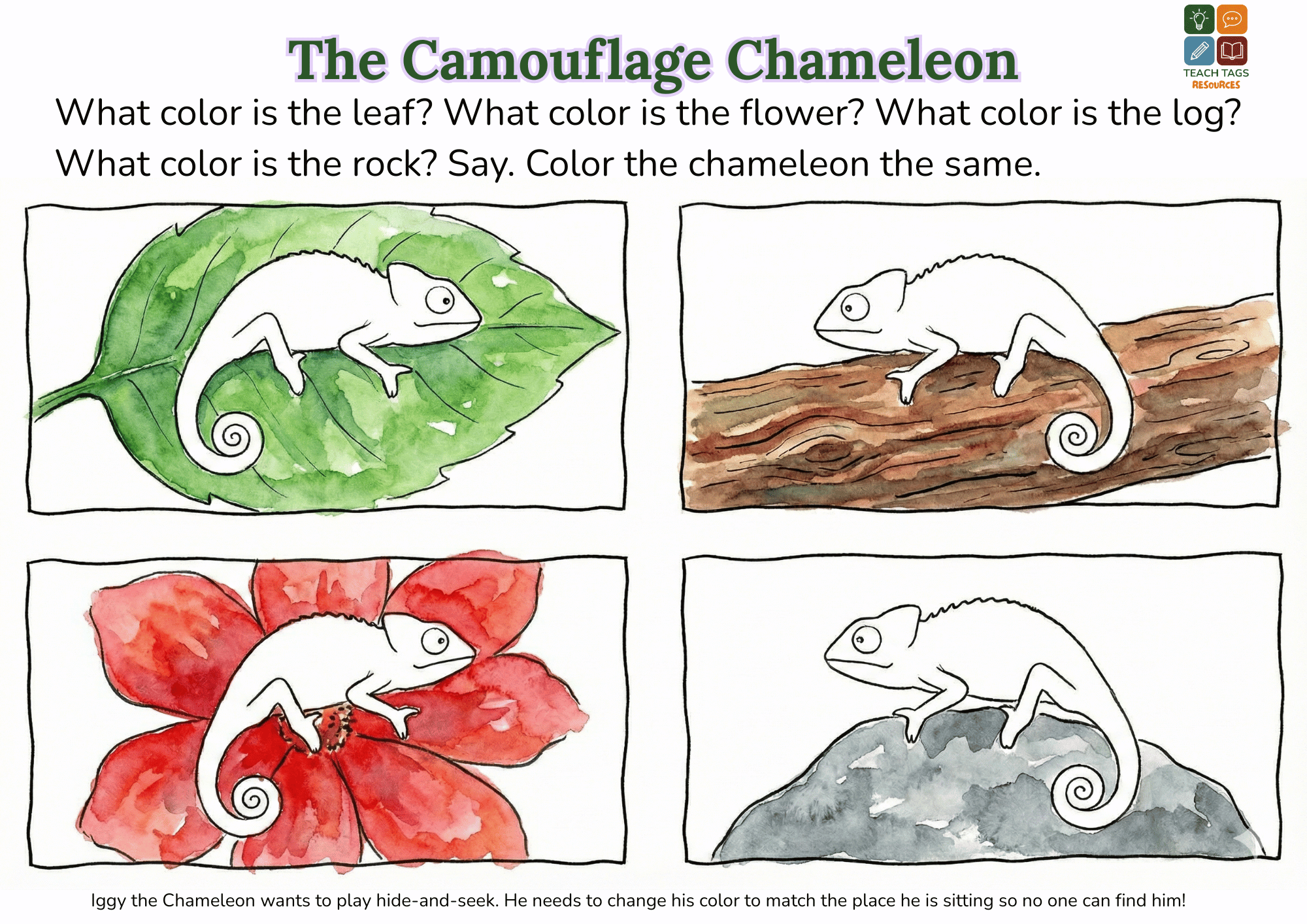
This engaging worksheet is designed for early learners (Preschool to Kindergarten) to practice color recognition and matching skills through a nature-themed activity. Students are invited to help “Iggy the Chameleon” play hide-and-seek by coloring him to blend in with four distinct backgrounds: a leaf, a log, a flower, and a rock. The resource combines simple reading comprehension with fine motor skill practice.
Target Vocabulary: Chameleon, leaf, flower, log, rock, green, red, brown, grey, camouflage, hide-and-seek.
Activity:
- Observation: Identify the background object in each of the four panels.
- Speaking: Answer the prompt questions aloud (e.g., “What color is the leaf?”).
- Coloring: Select the correct crayon or marker and color the blank chameleon to match its surroundings (Green for the leaf, Brown for the log, Red for the flower, Grey for the rock).
Learning Goal: To reinforce color vocabulary and object recognition while introducing the basic scientific concept of camouflage (blending in) through creative artistic application.
| Textbook Name | Unit Number & Title | Context / Notes |
| Oxford Discover 1 (2nd Edition) | Unit 5: The Chameleon (Big Question: How do animals hide?) | Exact Match for Worksheet 2. This unit explicitly teaches the concept of camouflage. The main reading text is non-fiction titled “The Chameleon,” which discusses how chameleons change color to match their surroundings (leaves, branches). It perfectly aligns with the “Camouflage Chameleon” worksheet. |
| Let’s Go 1 (5th Edition) | Unit 1: Things for School (Section: Let’s Learn – Colors) | Strong Match for Worksheet 1. This unit introduces the core color vocabulary found in the balloon worksheet: Red, Blue, Yellow, Green, and Purple. It uses the specific sentence pattern “It is [color],” which supports the “Say” activity in the worksheet. |
| Our World 1 (2nd Edition) | Unit 3: Colors | Thematic Match for Both. As a National Geographic Learning title, this series uses high-quality nature photography. Unit 3 teaches colors specifically through the lens of nature (e.g., green frogs, red flowers), bridging the gap between the simple balloon exercise and the nature-based chameleon exercise. |
| Family and Friends 1 (2nd Edition) | Starter Unit: Hello! & Unit 3: This is my nose! | Foundational Match. The Starter Unit covers the colors Red, Green, Blue, and Yellow immediately. Unit 3 often expands on descriptive adjectives. This is a classic choice for the “Lost Balloons” drill activity. |
| Super Minds 1 (2nd Edition) | Unit 2: Let’s Play! | Vocabulary Match. While focused on toys, this unit heavily drills color adjectives combined with nouns (e.g., “a green go-kart”). It aligns well with the “colored t-shirt” aspect of the balloon worksheet, teaching students to describe objects by their color attributes. |